


Secure, Scale, and Grow.

Delivering high-trust, future-ready software solutions to grow with your business.

OUR PARTNERS

Filters

Ksatria announces the release of KMS, an end-to-end hospital information system (HIS) that can integrate all the hospital processes starting from registration, clinical process up to back office processes.

Streamlining a hospital business process will ensure operational effectiveness which will subsequently provide better services to the patients, as well as improve the hospital’s management and bottom line.

What’s new in KMS?

Build-in finance system

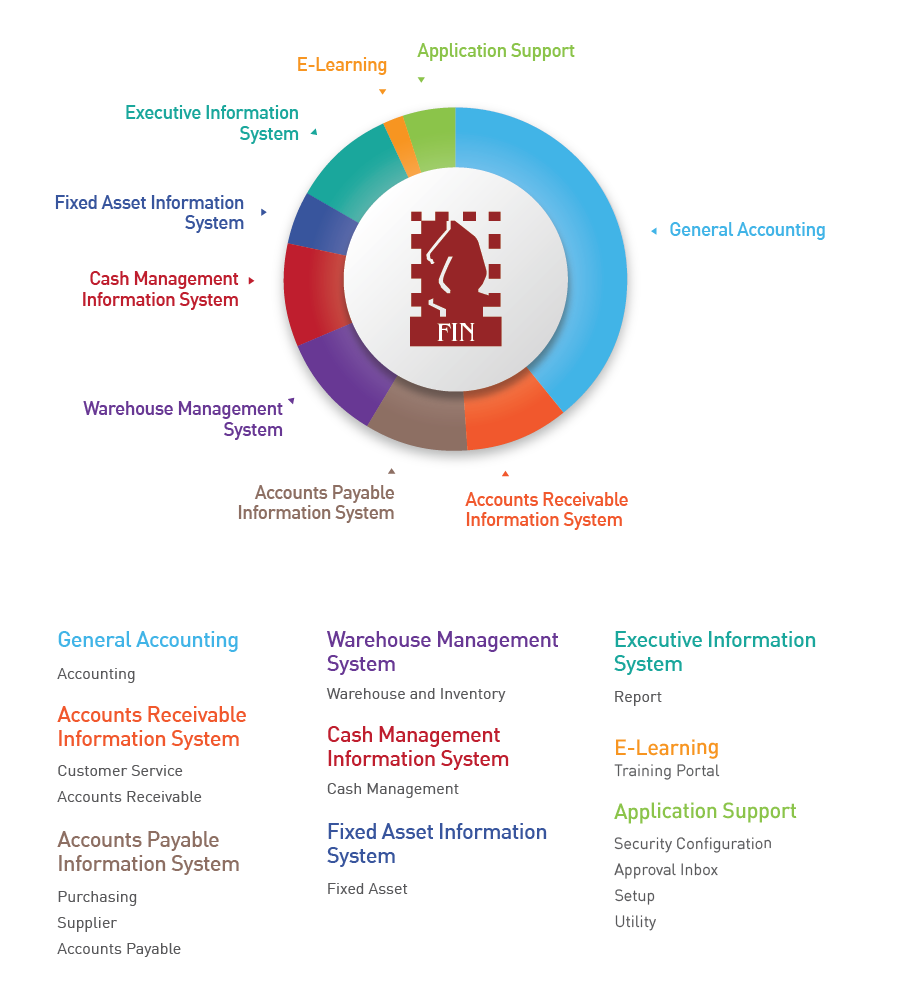
KMS is equipped with the KMS-FIN, an out-of-the-box, seamlessly integrated accounting system that automatically generates journal entries for all transactions. Combined with the new module, Doctor Compensation, that records and regulates doctors’ arrangement with the hospitals, Finance Department can easily keep track of all transactions and use the stored data to generate income taxes easily.
Electronic Medical Record (EMR)

KMS comes with electronic patient medical record that covers all clinical services, allowing patient’s records to become accessible from any point of care, providing doctors with complete and updated patient information to help establish a proper diagnosis and determine the appropriate treatment.

Computerized Physician Order Entry (CPOE)

The upgrade to v.5.3 includes a more advanced and complete set of clinical functionalities, including CPOE and e-prescription. CPOE gives doctors the ability to create prescriptions, referrals and service orders that will be sent out to the appropriate follow-up service providers directly from the examination screen, hence accelerating the patient service flow by cutting down the excessive paperwork.

Integration Module

KMS supports integration with other applications, including HL7 integration with hospital’s Laboratory Information System (LIS) and Radiology Information System (RIS), so doctors can automatically receive examination and imaging results from diagnostic equipment. This saves time and reduces possibility of error in handling the patients’ diagnostic examination results. Similarly, its interoperability module enables KMS to integrate with popular third-party accounting systems that the hospitals might be using.

Integration with BPJS

In light of the Indonesian government mandatory Healthcare Social Security System (BPJS) implementation, hospitals have to install two new applications in their system: Eligibilitas Peserta (SEP) and Case Base Groups (INACBG). In a normal situation, this means the hospital will have to operate three applications in their day to day activities. KMS’s database can be integrated with the SEP and INACBG, saving time that can be used to serve more patients.

KMS is built in compliance with the Indonesian laws and addresses most of the concerns that Indonesian hospitals are facing. Its comprehensive Master Patient Index prevents duplication in patients’ electronic medical records and makes them accessible at any point of care. The integrated nature of KMS helps getting payment leakage under control and promote better coordination between hospital staff and facilities scheduling.

These are only some of the problems that Indonesian hospitals can solve using KMS. With KMS, hospitals can increase the efficiency of their operations and therefore offer better services to more patients.

Electronic Medical Record (EMR)

KMS comes with electronic patient medical record that covers all clinical services, allowing patient’s records to become accessible from any point of care, providing doctors with complete and updated patient information to help establish a proper diagnosis and determine the appropriate treatment.

Computerized Physician Order Entry (CPOE)

The upgrade to v.5.3 includes a more advanced and complete set of clinical functionalities, including CPOE and e-prescription. CPOE gives doctors the ability to create prescriptions, referrals and service orders that will be sent out to the appropriate follow-up service providers directly from the examination screen, hence accelerating the patient service flow by cutting down the excessive paperwork.

Integration Module

KMS supports integration with other applications, including HL7 integration with hospital’s Laboratory Information System (LIS) and Radiology Information System (RIS), so doctors can automatically receive examination and imaging results from diagnostic equipment. This saves time and reduces possibility of error in handling the patients’ diagnostic examination results. Similarly, its interoperability module enables KMS to integrate with popular third-party accounting systems that the hospitals might be using.

Integration with BPJS

In light of the Indonesian government mandatory Healthcare Social Security System (BPJS) implementation, hospitals have to install two new applications in their system: Eligibilitas Peserta (SEP) and Case Base Groups (INACBG). In a normal situation, this means the hospital will have to operate three applications in their day to day activities. KMS’s database can be integrated with the SEP and INACBG, saving time that can be used to serve more patients.

KMS is built in compliance with the Indonesian laws and addresses most of the concerns that Indonesian hospitals are facing. Its comprehensive Master Patient Index prevents duplication in patients’ electronic medical records and makes them accessible at any point of care. The integrated nature of KMS helps getting payment leakage under control and promote better coordination between hospital staff and facilities scheduling.

These are only some of the problems that Indonesian hospitals can solve using KMS. With KMS, hospitals can increase the efficiency of their operations and therefore offer better services to more patients.

Electronic Medical Record (EMR)

KMS comes with electronic patient medical record that covers all clinical services, allowing patient’s records to become accessible from any point of care, providing doctors with complete and updated patient information to help establish a proper diagnosis and determine the appropriate treatment.

Computerized Physician Order Entry (CPOE)

The upgrade to v.5.3 includes a more advanced and complete set of clinical functionalities, including CPOE and e-prescription. CPOE gives doctors the ability to create prescriptions, referrals and service orders that will be sent out to the appropriate follow-up service providers directly from the examination screen, hence accelerating the patient service flow by cutting down the excessive paperwork.

Integration Module

KMS supports integration with other applications, including HL7 integration with hospital’s Laboratory Information System (LIS) and Radiology Information System (RIS), so doctors can automatically receive examination and imaging results from diagnostic equipment. This saves time and reduces possibility of error in handling the patients’ diagnostic examination results. Similarly, its interoperability module enables KMS to integrate with popular third-party accounting systems that the hospitals might be using.

Integration with BPJS

In light of the Indonesian government mandatory Healthcare Social Security System (BPJS) implementation, hospitals have to install two new applications in their system: Eligibilitas Peserta (SEP) and Case Base Groups (INACBG). In a normal situation, this means the hospital will have to operate three applications in their day to day activities. KMS’s database can be integrated with the SEP and INACBG, saving time that can be used to serve more patients.

KMS is built in compliance with the Indonesian laws and addresses most of the concerns that Indonesian hospitals are facing. Its comprehensive Master Patient Index prevents duplication in patients’ electronic medical records and makes them accessible at any point of care. The integrated nature of KMS helps getting payment leakage under control and promote better coordination between hospital staff and facilities scheduling.

These are only some of the problems that Indonesian hospitals can solve using KMS. With KMS, hospitals can increase the efficiency of their operations and therefore offer better services to more patients.
One of the major benefits that Indonesian hospitals can enjoy recently from the Ksatria Medical Systems (KMS) is its capability to integrate with the Indonesian government mandated Healthcare Social Security System (BPJS)’ applications: Eligibilitas Peserta (SEP) that validates patient’s BPJS membership, and Case Base Groups (INACBG) that collects and submits the data required to claim the insurance for services rendered.

BPJS is a universal health scheme rolled out by the Indonesian government in cooperation with the public and private hospitals in the country to provide every Indonesian citizen with proper healthcare services. The introduction of SEP and INACBG translates to double work for hospitals that employs their own hospital information system (HIS), as the staff have to enter the same information – the patient’s data and the services they use – twice into three separate systems.

To respond to this challenge, KMS now supports the ability to integrate with BPJS applications using web services framework. Through the web-based interface, hospital staffs only need to enter the data once and the integrated system will automatically distribute the information into the appropriate sections of the hospitals’ HIS and the BPJS-mandated applications. This improvement significantly reduces patient service time and ensures neat recording of BPJS’ services rendered billing and insurance claim.

No double-entry is required after the integration, meaning it cuts down the time needed to enter the patient’s data during registration and the details and cost of services rendered. Allowing hospital to serve more patients in the same amount of time.

The integration prevents disparity in the data inputted into the applications due to human error. It also makes the billing process and insurance claim process easier and neater.

The BPJS integration capability has been successfully implemented in PT Freeport Indonesia’s hospital. The hospital is now enjoying a system that streamlines three separate applications, increasing efficiency in time, operational as well as service management, hence improving the hospital’s overall productivity.

“Mitrais is in touch with the development and needs of Indonesian healthcare industry and we strive to provide the best solution to help hospitals with their everyday tasks,” Handi Ferryandi, Mitrais’ Sales Director said. “The BPJS integration in KMS is a strong example of our dedication to support Indonesian hospitals with HIS, but it is hardly the only one.”

In addition to the BPJS integration capability, KMS HIS, is also equipped with built-in finance system, better clinical functions, Electronic Medical Record (EMR), Computerized Physician Order Entry (CPOE), and more sophisticated integration modules. KMS is now an end-to-end HIS covering all hospital process starting from registration, clinical process up to back office processes.

A senior official in one of Indonesia’s hospitals recently said some of their staff found the authorisation controls in Ksatria Medical Systems (KMS) restricting.

Unperturbed, Mitrais’ VP Software Products Services She Kun responded, “Exactly. In my experience people will naturally go looking for shortcuts. However, authorisation controls are indispensable in protecting your hospital.”

The recent and still raging vaccine fraud scandal that is plaguing Indonesia is one example of dangers that hospitals face from an insufficient regulation over drug purchasing activities. As mentioned by the national food and drugs monitoring body (BPOM), quoted in one of the Indonesian newspaper, the pharmaceutical procurement at health facilities is uncontrollable.

She Kun observed that for the sake of speeding up the procurement process, often one person is responsible over the complete drug purchase cycle, starting from requisition, sourcing, until receiving.

“Taking shortcuts like these, while expediting the workflow significantly, poses a vital threat to the hospital’s wellbeing in the long run,” he said. “No regulated authorization for the processes makes it vulnerable to corruption, nepotism, and as we have recently discovered, fraud.”

The culprits managed to get away with their crime partly because most hospitals are recording their activities manually. By installing an integrated hospital information system (HIS), staff can monitor the hospital’s daily activities in real time. Not to mention it makes authorisation control easy to manage and executed. Another side effect that will help with the hospital’s internal control is the development of Standard Operating Procedure (SOP).

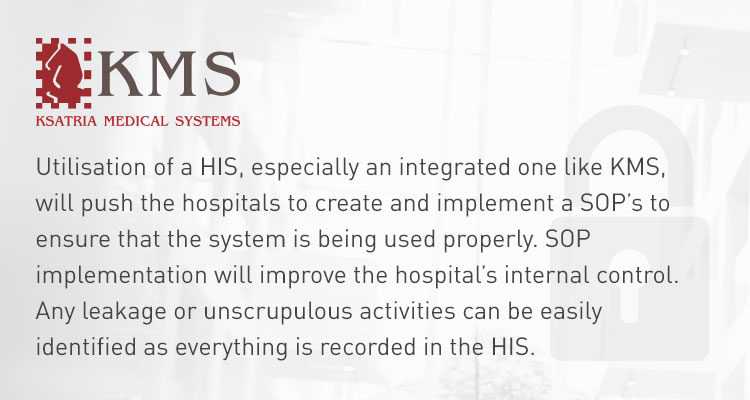
“Utilisation of a HIS, especially an integrated one like KMS, will push the hospitals to create and implement a SOP’s to ensure that the system is being used properly,” She Kun said. “SOP implementation will improve the hospital’s internal control. Any leakage or unscrupulous activities can be easily identified as everything is recorded in the HIS.”

The SOP for purchasing activities can include a rigorous selection of the suppliers and a series of steps with different people in charge that, instead of a processed centralized by a small group of individuals, will form a proper and well thought-out procedure to be followed. This clear separation of duties will promote transparency and reduce the opportunity for corruption.

From the data collected in the system, hospitals can easily examine the trend for drugs purchase and sales. Medicine is one of the most important work capitals in hospitals, hence hospitals can only benefit from proper documentation and reporting.

“With the reports of past transaction available with a click of a button, hospitals can anticipate the drug movement and determine which ones are slow or fast moving to plan the purchasing accordingly,” explained the vice president. “Similarly, looking back at the purchase history, the hospital can compile data on how much they bought from certain suppliers and how often and thus earn a bargaining power for bulk-buying. This also help monitor the quality of drugs provided by suppliers.”

KMS has a reporting feature that makes things easier for the hospitals. Ksatria has just recently released the latest version of their flagship, the KMS a fully integrated end-to-end Hospital Information System (HIS) that handles all hospital processes up to the back-office requirements. Developed to fulfil the needs of Indonesian hospitals, KMS is equipped with advanced authorisation control function, built-in finance system, enhanced clinical capabilities, thorough integration module which also allow it to integrate with popular third-party finance systems.

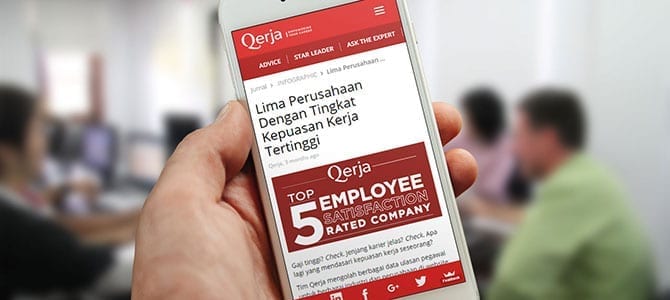
Mitrais is rated in the top 5 Indonesian IT & telecommunication companies to work for, according to Qerja.com. On a separate occasion,  Jobplanet also places Mitrais within the ten best Indonesian companies in terms of work and life balance.

The two websites are communities where employees can share their working experience and opinions on their employers. Their compiled reviews have greatly contributed to Mitrais’ ranking in Qerja.com and Jobplanet.

The results reflect employees’ satisfaction and the measurement includes but is not limited to factors such as the compensation and benefits, career development opportunities, work-life balance, as well as the company’s values, cultures and management style.

Mitrais endeavours to provide the best working environment for our employees that is also conducive to their personal and career development.

Mitrais has a comprehensive competency system and staff are encouraged to continually assess their competence, Business English classes are one of the many business and training courses offered at Mitrais. By taking the offered classes and online learning offerings, staff can improve their capabilities and advance their career easily.

Mitrais work-life balance

Company-endorsed social clubs cater to the staff’s interest in activities like badminton, snorkelling, futsal and other hobbies. Through these clubs Mitrais staff can share their talent and passion with people of similar interest within the company, strengthening the bond between staff. Mitrais also regularly schedule fun outing that serves as teambuilding sessions in all our offices.

We would like to thank all our staff for their endorsement and contribution that make our working place feel less like an office and more of a second home.

In an interview with the Australian Financial Review, one of the country’s leading financial news agency in, Mitrais’ Group CEO David Magson talked about offshore software development and the how Indonesia is a fertile soil for growing IT businesses.

Mitrais has been established long before the world looks at Indonesia as a potential IT business ventures. The company’s operations focuses on software services, mining and medical IT, working primarily with the Australian and ASEAN market.

If you’re wondering why one of Mitrais’ software development centres is position in Bali, an island that is more known for its tourism than IT, David will explain how it is a fitting place for growing a software development company.

Read the full article here!

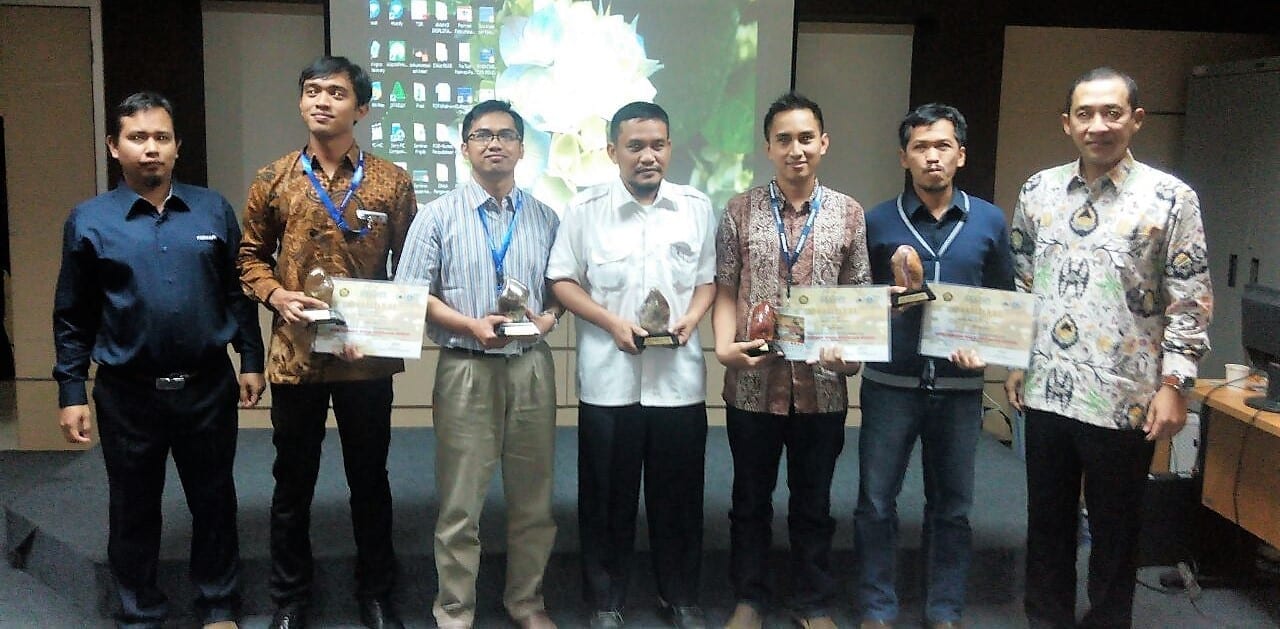
Aditya Ari Marindra, Mitrais’ sales managers, had the honor of presenting his research in the Temu Profesi Tahunan (TPT) XXV 2016 held by the Association of Indonesian Mining Professionals (PERHAPI) recently in Bandung.

The TPT this year is held with the objective to promote synergy to build Indonesian mining industry. The PERHAPI invited mining professionals and academia to present their research results which can benefit the industry as a whole.

Aditya was given the opportunity to present on his research paper, titled “Hauling Road Optimization for Fuels Consumption Efficiency”, in which he investigated the effects of road’s grade steepness and conditions on the fuel consumption during haulage.

“Operational cost is largely made up of fuel consumption that is assumed to be directly proportional to the distance covered,” Aditya said. “My research shows that that is not always the case.”

In addition to distance, the steepness of the road’s grade as well as its condition contribute to the increasing the haulage truck’s burden, consequently burning fuel faster. In such condition, even a short distance can consume quite a lot of fuel.

Using Spry Scheduler, a mine scheduling and haulage solution, Aditya produced two scenarios with differing distance and road grades to measure the engine load factor, engine power used, and how much the rate of fuel consumption is affected.

The conclusion of the experiment shows a higher rate of fuel consumption for a truck that went through a roads with steeper grade and varying conditions. It means, to avoid using up so much fuel in the transporting of mine product, the haulage routes should be planned on road with gentler grades steepness and optimal conditions.

“With my research, I hope mining technicians will take into account the road’s grade steepness when they are considering the haulage route so that they can plan the best route with best road condition to save operational cost, especially the fuel cost,” concluded Aditya.

As a statement of its support for the Indonesian IT industry’s development, Mitrais became one of the sponsors for the 3rd International Conference on Data and Software Engineering (ICoDSE 2016). Taking part in promoting development and growth of IT education field is one of Mitrais’ corporate social responsibilities meant to give back to the society we operate in.

Taking up the theme “Knowledge Engineering and Software Engineering in the Era of Internet of Things (IoT)”, the ICoDSE 2016 invited many researchers to present their papers on data and software engineering, two vastly developing areas in the IT industry. Only selected, high-quality research papers would have the opportunity to be presented during the two-day event.

This year’s conference welcomed several notable keynote speakers. They were Ahmad Bambang from Pertamina Indonesia, Benhard Sitohang from Bandung Institute of Technology, Prof. Michel Chaudron from Sweden’s Chalmers University and Dr. Elmar Kiesling from Vienna University of Technology.

The keynote speakers covered different facets of knowledge and software engineering, including Big knowledge, the challenge for knowledge-based approaches in model-based software engineering, and the changes over the years in IT development processes, dubbed the ‘Tectonics of Data and Software Engineering’.

“The international conference like this is the perfect venue for IT professionals to make themselves heard. It is also a good opportunity to showcase how much Indonesian IT industry has improved over the years,” said Gusti Putu Kompiang, Mitrais’ VP Services who was in attendance to represent the company.

The conference took place at the Udayana University in Bali from 26th to 27th October 2016 and featured more than 60 papers presented by researchers from around the world, including Indonesia, Malaysia, Singapore, USA, and Austria.

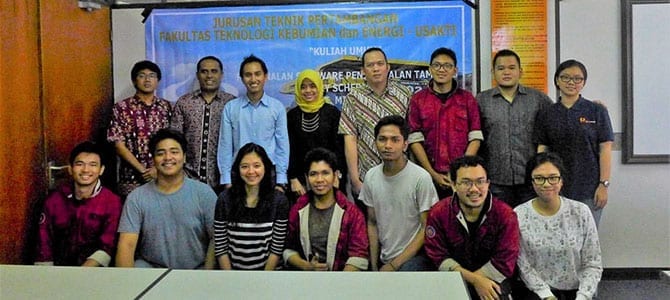
In December, Mitrais’ sales manager Aditya Ari Marindra became a guest lecturer in a workshop for mining scheduling at the Trisakti University, Jakarta, as a part of Mitrais’ cooperation with Indonesian universities to encourage the growth of high quality graduates for the mining industry.

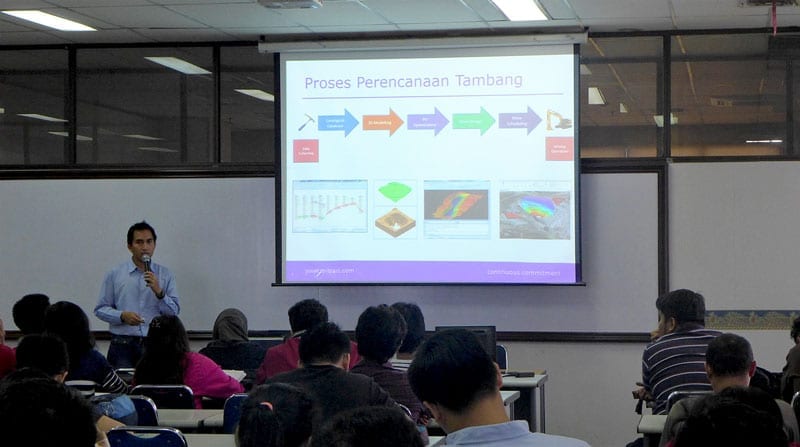
Aditya explained the mining process with emphasize on the scheduling process, in particular how to take advantage of technological advancement and use mining software to produce the best, fastest and most accurate mining schedule. In this instance, the Spry Scheduler.

He demonstrated how the fully featured mine scheduling solution, Spry Scheduler has the capability to analyze and simulate different mining and haulage scenarios based on the perimeters entered by the user. The simulations are presented using attractive and easy to understand 3D graphics. Aditya also explained the reporting feature of the Spry Scheduler and how easily it extracts the required information in the desired format, be it graphs or table.

Aditya presentation at Trisakti University

Another advantage of the Spry Scheduler is its capability to fully integrate with MineScape, the leading mine planning software that is popular among Indonesian mining companies.

“The students were very attentive and active. They asked many insightful questions,” Aditya commented, happy to see such eagerness in the future mining professional.

Trisakti University is one of the many educational institutes that Mitrais has collaborated with over the years and by far, will not be the last one.

Senior manager of exploration & mine planning solutions Ida Farida who accompanied Aditya during the trip stated, “We hope that our collaboration with the universities will continue so that Mitrais can keep contributing to the community. It is a great honour to take part in shaping a better generation of mining professionals.”

By: Irna Fitriani, Mitrais Analyst Programmer

In June 2014 Apple released Swift as another alternative for the software developer to develop applications for native iOS. Since then the Swift language has iterated rapidly. Swift has released several major and minor versions and released Swift 3.0.1 in October 2016.

Critics of Swift claim the product is immature compared to Objective – C, especially for medium to large projects. Before deciding which one we should we learn first, let’s explore the reason that Apple created Swift in the first place.

Why Apple Created Swift

Apple’s company culture and vision is “an obsession with end-to-end design and seamless hardware –software-development integration.”

However, the original native iOS language, Objective–C attracted a lot of criticism as it is notoriously hard to learn for a beginner.

Apart from being much easier to learn, Swift is fast.

Swift was developed as a replacement for C-based languages (C, C++, and Objective-C). As such, Swift must be comparable to those languages in performance for most tasks. Performance must also be predictable and consistent, not just fast in short bursts that require clean-up later. There are lots of languages with novel features – being fast is rare.

Swift is easier

Objective-C suffers from all of the warts you’d expect from a language built on C. To differentiate keywords and types from C types, Objective-C introduced new keywords using the @ symbol. Because Swift isn’t built on C, it can unify all the keywords and remove the numerous @ symbols in front of every Objective-C type or object-related keyword.

Swift drops legacy conventions. Thus, you no longer need semicolons to end lines or parenthesis to surround conditional expressions inside if/else statements. Another large change is that method calls do not nest inside each other resulting in brackets. Method and function calls in Swift use the industry-standard comma-separated list of parameters within parentheses. The result is a cleaner, more expressive language with a simplified syntax and grammar.

Swift code more closely resembles natural English, in addition to other modern popular programming languages. This readability makes it easier for existing programmers from JavaScript, Java, Python, C#, and C++ to adopt Swift into their tool chain – unlike the Objective-C.

Swift is safer

In Objective-C, if a value was returned from a method, it was the programmer’s responsibility to document the behavior of the pointer variable returned (using comments and method-naming conventions). In Swift, the optional types and value types make it explicitly clear in the method definition if the value exists or if it has the potential to be optional (that is, the value may exist or it may be null).

To provide predictable behavior Swift triggers a runtime crash if a null optional variable is used. This crash provides consistent behavior, which eases the bug-fixing process because it forces the programmer to fix the issue right away. The Swift runtime crash will stop on the line of code where a null optional variable has been used. This means the bug will be fixed sooner or avoided entirely in Swift code.

Swift requires less code

Swift only needs 1 file which is .swift compared to Objective-C which uses 2 files .h and .m and of course it requires less code than Objective-C. For example, in Objective-C working with text strings is very verbose and requires many steps to combine two pieces of information. Swift adopts modern programming language features like adding two strings together with a “+” operator, which is missing in Objective-C.

Swift: The more approachable, full-featured language

With Swift, programmers have half as many code files to maintain, zero manual code synchronization, and far less punctuation to mis-type – leading to more time spent writing quality lines of code.

Code is now self-documenting in Swift with the addition of optional types: a compile-time safety mechanism for returning a value or no value, which is a common issue with asynchronous operations, network failures, invalid user input, or data validation errors. ARC is unified in Swift between both procedural C-style code, as well as object-oriented code using Apple’s Cocoa framework.

Developers will find that they write less code in Swift, and modern language features support them in keeping lines of code more readable. Swift will keep the entire Apple ecosystem at the forefront of programming as it continues to evolve, thanks to dynamic library support in iOS and Swift. Open source projects, third-party SDKs, and frameworks that integrate with home automation, devices, and social services will be easier to integrate without increasing build times. Swift is almost as fast as C++ in some algorithms.

Add to that the fact that Playgrounds and Swift enable a new way to program with visual feedback that assists the development of algorithms using inline data visualizations. A shorter feedback loop and graphical descriptions make the iterative coding process even easier to start.

Areas where Objective-c still better than swift

  • If you need to interact with an old C/C++ library, Objective-C is just way better.
  • If you are doing a lot of Video or Audio work. This can be done 100% with Swift, but I just find those iOS Libraries are a bit old and crusty and really lend themselves better to Objective-C.

Conclusion

Ultimately, Swift is a more approachable full-featured programming language that will allow developers to not only build apps but also target embedded systems like the new lower-power Apple Watch for many years to come.

Disclaimer: This article is an independent Mitrais publication and has not been authorized, sponsored, or otherwise approved by Apple Inc

By: Robby Maulana, Analyst Programmer at Mitrais

For many centuries the invention of new technology has changed people’s life, making many activities easier to do. Some people believe that technologies have negative impacts on social relationships. However, many think that technologies make their communication more effective than ever.

With the explosion of available information available to the average person in the 21st Century, managing documents, data and information has become increasingly important in people’s lives. The tools to work on documents, worksheets, and slide presentations more effectively are becoming more and more sophisticated, culminating in Microsoft’s cloud based Office 365.

Nowadays, people are able to utilize online document processing such as Office 365, that can be further customized using Apps for Office. It provides flexible and familiar tools for team collaboration across devices and platforms. It also provides data security and privacy compliance. This is a tool that allows everyone to work from any device.

Visual Studio Tools for Office (VSTO) uses the .NET Framework to customize and extend Office. VSTO fully supports the C# and Visual Basic languages and can therefore leverage the same frameworks, tools, and programming paradigms as the rest of the .NET Framework. VSTO also supports integration with the Office client applications, both in terms of the rich sets of APIs, and the customizability of the user interface.

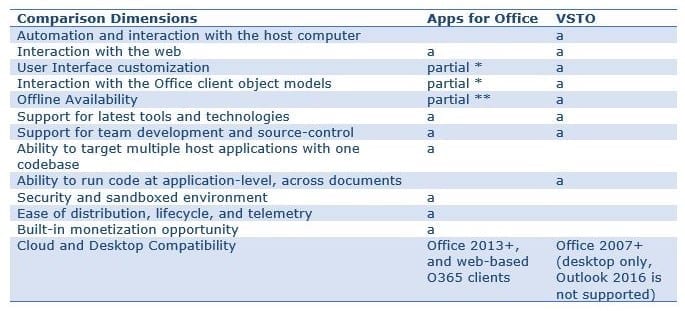
Generally, Microsoft supports Office customization using Apps or VSTO. Each technology has its pros and cons as described in the table below:

Apps for Office vs VSTO

Table 1 Apps for Office vs VSTO

a = available

*: Indicates a dimension where support might be partial today, but where future investments are expected to be made.

**: Relies on standard web offline capabilities (For example: AppCache, Web Storage, page caching) supported by the browser.

logging cloud document management

The basic difference between Apps for Office and VSTO is that Apps for Office runs in multiple platforms (web, mobile and desktop) while VSTO only supports desktop platforms. Apps for Office can support Office for Mac but VSTO can only run on a Windows platform since it uses .NET Framework.

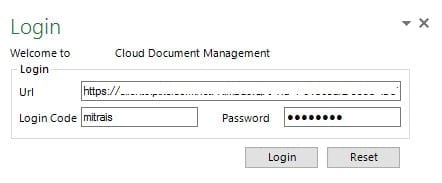
Figure 1 Login page using token based authentication via Web Service in VSTO Add In

vsto office login page

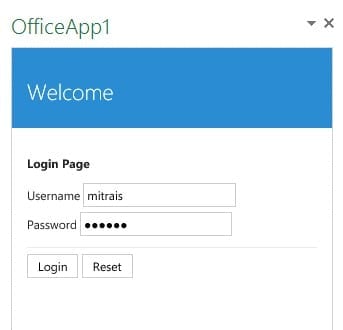
Figure 2 Login page using Apps for Office

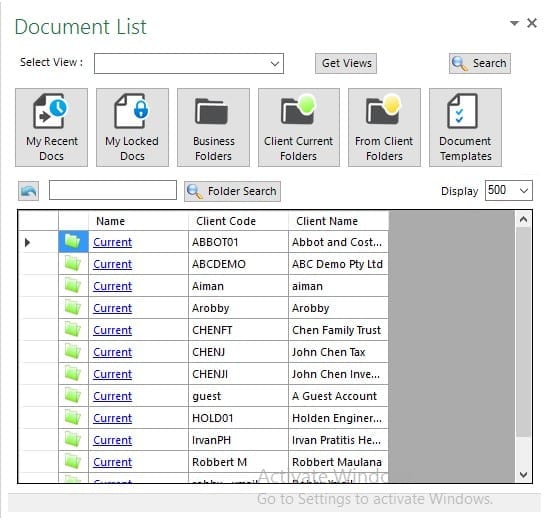
Both technologies support interaction with web services. Even if VSTO is primarily designed for desktop users, it can retrieve data from any web service and feed it to users via HTTP Requests. Apps for Office supports a limited UI customization, including: command, content and task pane but not backstage menu and context menu customization.

VSTO has better support on UI component customization but its styling capabilities are lacking. Apps for Office’s styling is supported by Fabric JS, which provides a better look and feel.

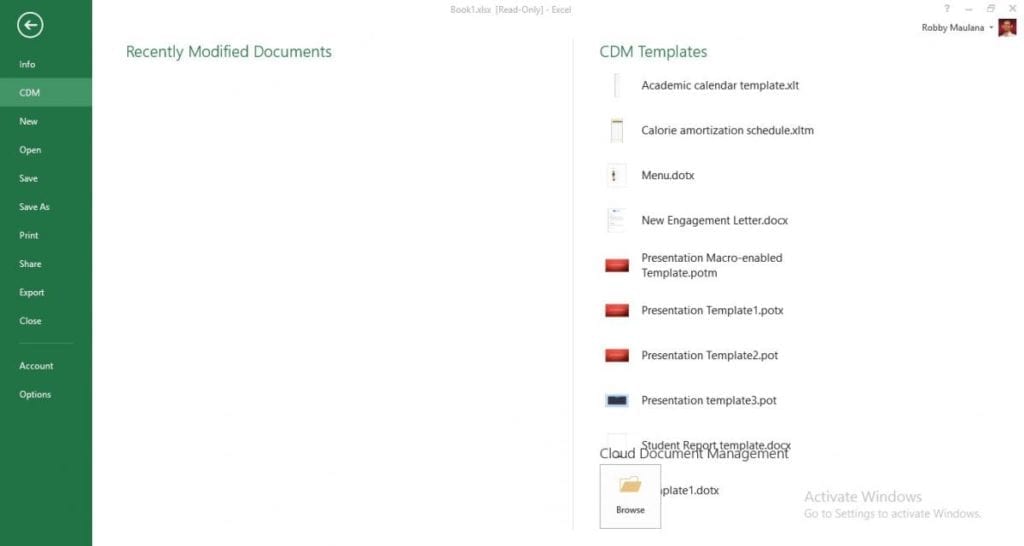
Backstage menu using VSTO

Figure 3 Task pane using VSTO

Figure 4 Customized Backstage menu using VSTO which Apps for Office can’t do

Object model provides classes and interfaces that represent the items within a user interface. For example, Microsoft.Office.Interop.Outlook.Application object represents the entire Outlook application.

VSTO can fully support interaction with Office client object models from various applications such as Outlook, Word, Excel, PowerPoint, Access, etc. On the other hand, Apps for Office only provides limited support for the Office client object models that are defined in JavaScript API for Office library.

In 2016, Apps for Office published the OneNote, Project and Access JavaScript API to access its object models. Apps for Office still has room for improvement.

Regarding apps development using Apps for Office, there are some aspects that need to be paid attention to such as:

  • No automation and interaction with host computer. Furthermore, since it is unable to store file to host computers and all the data is stored in the cloud and internet, the offline availability is limited.
  • No support for older Office versions, which people might still use.
  • Limited object client model means and UI customization.
  • No support for across document.

VSTO also has its drawbacks:

  • No ability to target multiple host applications with one codebase, meaning each code base is unique for a specific application, for instance the code base for Excel won’t work for Word or Outlook. However, there is a workaround to share reusable components or objects across applications.
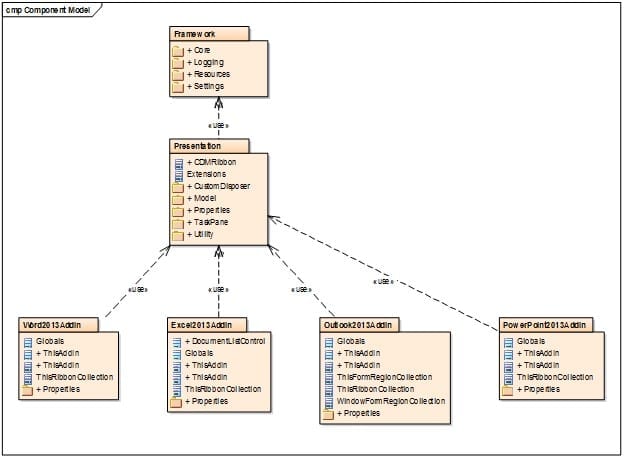
Component Model Architechture

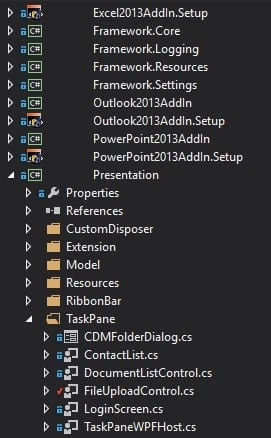
Figure 5 Improved architecture for Office Add In development using VSTO

Presentation component which reusable across Office application

Figure 6 Presentation component which reusable across Office application.

  • Need to implement data security using token based authentication when requesting data to web service.
  • Need to create an installation bundle project using Windows Installer XML (Wix) toolset to support chaining installation (prerequisites software and add-in). Prerequisites are .NET Framework and VSTO Runtime.
  • No monetization. Add-in should be developed as supporting software in addition to the main services.

Conclusion

Given the variety of choices between Apps for Office, VSTO add-ins and macros, it is important for developers to know the value of each tool.

VSTO add-ins and macros are solutions aimed at solving the users’ needs and will continue to be supported by the desktop platform. Meanwhile, Apps for Office comes with a forward-looking platform (web, mobile, desktop, Mac). It is aimed at bringing web services and web technologies closer to Office developers.

These VSTO add-ins and macros for Office desktop are highly-customizable. Apps for Office is implemented by exposing loosely-coupled web functionality using the chosen web technology with monetization potential, IT governance and ease of lifecycle management and deployment. It is better-suited for creating easily deployable web based solutions that can work across platforms, including the cloud.

In cases where multiple approaches are equally possible, Apps for Office is a natural preference for new projects. For better compatibility with older version of Office desktop, automation to host computer and full UI customization, VSTO still one of the best choices.