











Mitrais Cyber Security Solutions

Cyber Security Solutions

Mitrais protects your business against ransomware and targeted attacks with our cyber security solutions & products that prevent, detect, and respond to emerging security threats from your servers, cloud services, and devices. Our experts conduct a cyber security risk assessment on your current IT environment, determine possible weaknesses from the local, remote, cloud, containerised, or virtual infrastructure, and create solutions to solve the problems. Our cybersecurity solution will ensure your organisation has the right assurance to ensure you stay safe, secure, and protected.

Our Certification

ISO 27001
Certified

Products Category

Network & Perimeter Security

Next-generation protection safeguards your company’s intranet, company networks, and external network boundaries from hackers, intruders, or perpetrators. It includes detection, analyzing patterns, determining threats, and protecting your company’s assets from internal or external sources. This solution include: Next-gen Firewall (NGFW), Web Application Firewall (WAF), Intrusion Prevention System (IPS), Advanced Threat Protection/ Defense (ATP/ATD), Anti DDoS

Web & Mail Security

Solutions that protect users from web-based or advanced email threats like malware, ransomware, or impersonation, develop and enforce internal policies, filter users’ Internet and email, clean data and form a security service that on-site or remote users can use. This solution include: Secure Web gateway, Web isolation, Mail isolation, Phishing protection

Endpoint Security

The cybersecurity front line protects all vulnerable entry points for end-users like laptops, desktops, and mobile devices from cybersecurity threats. This solution include: Endpoint protection, Endpoint Detection and Response (EDR) / Extended Detection and Response (XDR), Data Loss Prevention (DLP), Vulnerability Management

Asset Management and Monitoring

Centralized data management and tracking of your company-wide assets and protection of your IT assets, services, processes, and networks will ensure your company runs safely and securely. This solution include: IT Asset Management, Service desk Management, Network Monitoring System (NMS), SIEM

Cloud Security

A collection sets of policies, controls, procedures, and technologies to protect business cloud systems, data, and services from the cyberthreats

Application Security

Security protection at the application level by finding the vulnerabilities, fixing, and enhancing the security of the application throughout the entire application lifecycle.

Database Security

Security measures used to protect database systems from malicious attacks and illegitimate use, designed to establish database confidentiality, integrity, and availability.

Threat Intelligence

A solution that combines multiple feeds of data about attack signatures and threat actors, providing additional context for security events and improving the security analysis.

Our Partners

Speak with an Specialist

Book a complimentary consultation with an experienced product specialist.
Schedule a meeting today.

Services Category

Cybersecurity Consulting

A comprehensive assessment of cyber security process and systems in a detailed report with solutions and recommendations of best practices, policies, and procedures to mitigate the cyber threat risk.

Vulnerability Assessment

A technical assessment designed to yield as many security weaknesses as possible in the company environment, along with severity and remediation to mitigate the risk.

Penetration Testing

A simulated cyberattack designed to validate specific exploitation points and areas of high vulnerability.

Trend Micro Managed Services

Mitrais delivers comprehensive cybersecurity solutions with Trend Micro, offering expert guidance, integration, and managed services to protect your business.

Palo Alto Networks Managed Services

We provides expert Palo Alto Networks cybersecurity solutions, including assessment, integration, and managed services to secure and strengthen your business.

TESTIMONIALS

Trusted by

Some clients that we developed products for expanded into new markets with measurable success. Let’s get
you on that list.

Frequently Asked Questions

Kustian – Mitrais’ “Accidental” Expert

Some people know from an early age exactly what they want to be. They have a relative in a profession who they long to emulate, or they are inspired by someone from a book, television show or movie that they see who sets them on the path to their career. For others like Kustian, though, expertise in a field and the successful career that follows sneaks up on them without their even noticing.

Today, he is one of the highly acknowledged Technology Evangelists within Mitrais, with specialised knowledge in complex Java solutions that benefits our clients and teams every day. He is in demand as a trainer involved in Mitrais’ internal training, and often appears as a speaker on technical matters at Mitrais sponsored events. But is wasn’t always his plan.

Born in Bandung, one of Kustian’s earliest memory is being a huge fan of the classic Sesame Street. At the time, it was just great fun, but in hindsight he is sure that it was an invaluable aid in learning English at a very young age. He “accidentally” acquired a language skill that was to be a key factor in his schooling and the great career to come, but this wasn’t the last time such an accident would happen to him.

Taking advantage of that head start, Kustian went on to study in elementary a high school in Bandung. Immediately following his graduation, he was offered a scholarship at the prestigious STIE-STMIK (now known as Universitas Nasional PASIM) to study Information Management. It was during this time that Kustian first found himself becoming interested in programming. As he was completing his dissertation, Kustian was offered a few month’s work on the island of Kalimantan, and he suspended his study briefly to experience this. On his return, he resumed his studies from Jakarta while working there. After nine months, though, Kustian missed his family in Bandung (particularly his young daughter), and he decided to relocate to home.

So, what to do next? His wife suggested that Kustian might apply to Mitrais. Unsurprisingly, he impressed at interview and was offered a position quickly. Welcome to the Mitrais family, Kustian! But what of this new career? Kustian says “I never dreamed of being in the IT world. I remember the first time I borrowed a programming book on Fortran from my local public library after high school graduation. I didn’t even realize that Fortran was a programming language at that time. In the end, I gave up on the book because it was too complicated to understand. I knew nothing about computer programming at that time. It’s funny to me that, even though I had DBASE, Chi-writer, and Clipper lessons in my junior high school, I never realized that those were programming lessons until I took my study in college. But thanks to those early lesson, I found programming studies easier at college. You could say that life dragged me into IT world!”

But still, Kustian wasn’t sure about his new direction. Although he applied to Indonesia Open University to study Management, he found himself constantly drawn to web articles about the latest IT technology. At the same time, he was fascinated by the hobby of hacking his phone (first Symbian and Blackberry, and eventually Android), and hacking mods for the games that he enjoyed. He was hooked, and clearly had talent in software development and modification.

So that’s what got Kustian back on track to his IT career. Since then, he has gone from strength to strength, becoming one of Mitrais’ leading experts, particularly in Java. In Mitrais, Kustian has been actively involved as a trainer on Mitrais’ internal courses, participated on out Java Bootcamps where other developers benefit from his experience, and become a key speaker at Mitrais’ sponsored events. And, of course, he is a valuable expert in formulating solutions for clients on significant projects. He seems to have found his home, even if it was by accident. But he still enjoys learning. As he says, “I enjoy being part of the IT world, but I have taken several other courses like “Learn how to learn” and “R Programming Language”, even though they are not directly related to my main skill – Java.”

Kustian remembers a great quote from a developer on a forum that he read long ago. “As a developer, we can make the world better”. He never asked that person exactly what they meant by that. But he thinks he understands now – “We are not just helping business to work better, but also the people, society and environment around those businesses”. And, in the end, accident or not, Kustian seems to be in the right place – and Mitrais is glad he is!

Upskilling Employees under the New Normal

A lot has changed in the past few weeks, and many organisations around the world have been left with no choice but to adapt to the rapid changes that the pandemic demands. We have all needed to take on a new set of routines to survive, and for businesses to keep running, many have turned to the technology to transition to remote working and providing services online.

Mitrais, one of the leading IT companies, is no exception. In addition to having a remote workforce, it has converted all its training to upgrade skills to fully online mode during the COVID-19 pandemic.

Narima, one of the Business Communication Trainers, said this situation had given her a chance to modify her training methods and materials by conducting fully online training that is still effective. The trainer needs to dig deeper, to be more creative, and a little bit tech-savvy to find the perfect combination of both the technological tools and suitable teaching methods to be able to keep the classes engaging and interesting.

“Trivia quizzes are a great way to assess the participants’ mastery of the materials. Icebreakers are used to warm up, other peer to peer interactions are implemented, and filler activities can be valuable to freshen the trainees in middle of a class” she explained. The trainer can always improvise. Of course, some additional effort is needed to keep the participants motivated during the virtual class, especially after working hours. It was very challenging for her to discover what would work best, and was quite time-consuming to prepare at the beginning. “Now that I am used to it, I can enjoy the rhythm” she added.

We received multiple responses from staff who are currently taking online learning this term. Deni, Business Development Consultant, said this virtual class was the best way to conduct the course during the pandemic. He can feel the effectiveness of this learning. “This helps to accommodate our needs. It is similar to the face to face training although it, somehow, takes more time to connect or move from one page to another” he said. Anang, an Analyst, agrees with Deni, “I have joined two online sessions including with the exam. The trainers delivered the material very effectively” he explained.

Narima has some tips for both the audience and presenter/trainer. “We need to make sure both are familiar with the virtual meeting platform before we even start the class, as technical issues in middle of a class can be very disruptive.” she explained. “Having meeting agreements or rules settled and published before the class starts is also essential to succeed in conducting an online class. Trainees’ cooperation is at the heart of it. I feel so blessed that not only are my trainees very cooperative, the other trainers are very supportive too with this “new normal”. It’s all fully online, but we can ensure that the goals are all well met” She said.

Working from home, learning, and teaching online may be a little daunting. However, this can open up exciting new opportunities for everyone to learn how to connect effectively in the future. “You know what they say, when things look black, there’s always a silver lining.” She said.

“I’ll see you all in the online classes. Until then, stay safe, stay healthy, and stay happy!” she added.

Working Software to Measure Project Progress

Since agile principles have been pushing us to produce working software in a shorter iteration, the backlog items are geared more toward the story completion, rather than toward the architecture layers slicing. This may sound like a simple concept, but it fixes the major issues that often occur in traditional waterfall projects. In waterfall projects, how the tasks are broken down and prioritised makes the working software demonstrated much later. Therefore, we often get a false sense of task completion.

A story describes how the user will interact with the system and what is expected. Story completion involves implementing some sets of functionalities which allow the user to interact with the system and produce the expected result. In earlier sprints, we may have not completed the stories with all the required functionalities, but they are still stories that allow the users to interact with the system under the development and show how they address the users’ needs. In agile terminology, it is called ‘business-facing’ test type. Business-facing tests address the users’ concerns rather than the developers’ concerns. User story completion is a great way to demonstrate that the software is working.

The method used to distribute the development tasks determines whether the working software can be used as a primary measure of the project progress. When the development tasks are distributed and prioritized based on the architecture layers (front end, middle layer, back end, etc.) or known as “horizontal slicing”, the working software may not be easily demonstrated in a short iteration. With horizontal slicing, we can still use mock-up, driver, or stub to test the architecture layers earlier. However, this requires the use of test automation and may not be a valid business-facing test. At the end of the sprint, not only the implementation of the stories committed for that sprint is demonstrated, but we mainly demonstrate that the software is working.

We will still need to ensure that the stories implemented in the previous sprints work well in the current sprint. Some of the stories considered ‘done’ in the previous sprints, could be broken now due to the changes in the source code during the development activities in a sprint.

In the traditional projects using waterfall, manual performing full regression may not be so much of an issue due to the longer durations between software releases. However, with the shorter iteration in the agile project, it may not be feasible to do proper regression tests for two-week sprints with manual testing. We would need to rely more on test automation to achieve this. Since scrum methodology allows a sprint duration of up to a month, we have the option of a longer sprint duration than the typical two-week sprints. This amount of time allows more proper regression testing to be done in each sprint, rather than having the testing cycle done outside of the sprint.

Working software is so much more than just a set of functional requirements being implemented. We also need to include non-functional requirements, such as performance, security, reliability, scalability, maintainability, and usability. While agile is not a traditional waterfall methodology, it will still hold that if we fail to include the non-functional backlog items incrementally, as appropriate in the earlier sprints; it will lead to large-scale refactoring later.

In today’s market, when the window of opportunity is open, it is important to maximize it and do the right thing to achieve the desired outcome. Missing the window of opportunity will result in a greater Cost of Delay. For instance, the original iPhone, released in 2007, didn’t have a copy-and-paste feature. Those functionalities were added 2 years later, on iPhone OS 3.0. As of 2020, iPhone still stays as one of the top 5 positions in smartphone sales worldwide. By adopting incremental working product deliveries in short iteration to show the progress, the Cost of Delay can be minimized. A good MVP (Minimum Viable Product) may not have all the nice-to-have features. However, with the set of important working functionalities implemented in a product and delivered at the right time, it could be a winner.

The Scrum Guide 2020, What’s New?

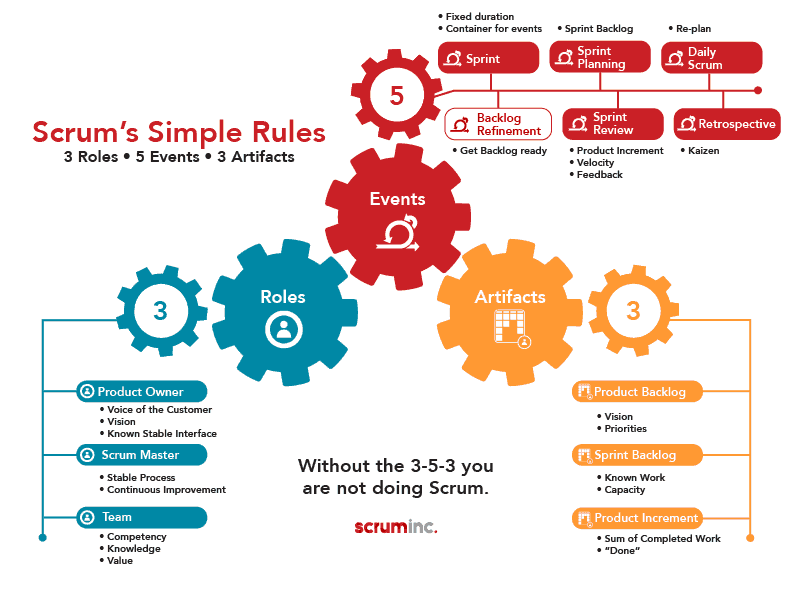
Ken Schwaber and Jeff Sutherland developed the first Scrum Guide in 2010 to help people worldwide understand Scrum, and have evolved the Guide since then through small, functional updates. This infographic portrays Scrum Guide 2020 that consists of Scrum’s roles, events, artifacts, and the rules that bind them together.