


FinTech Innovation, Built Securely. Engineered to Scale.

Delivering high-trust, future-ready software solutions to grow with your business.

OUR PARTNERS

The future of finance is fast, secure, and data driven. At Mitrais, we build smart, robust and compliant solutions that empower businesses in the FinTech industry.​

Custom FinTech Software Solutions

Drive digital transformation and boost performance with secure, compliant fintech solutions. Our ISO 27001:2022-certified cybersecurity, AI-driven analytics, and cloud infrastructure are tailored to your needs and regulatory requirements, enhancing decision-making and delivering high-performance results.

Cybersecurity First Approach

ISO 27001:2022-certified security, backed by Trend Micro & Palo Alto to safeguard financial data.​

Regulatory Compliance Made Easy

We develop custom solutions that align with ANZ financial regulations and global compliance frameworks.​

Advanced Technology Integration

AI capabilities for analytics, cloud-based infrastructure, and big data solutions to enhance decision-making.​

Mid-Tier Pricing Advantage:

Affordable, high-quality development for startups, SMEs, and mid-sized firms looking to scale

Custom Development Flexibility

Tailored financial software that adapts to your unique business model—because off-the-shelf just isn’t enough.​

Seamless Cloud & Data Engineering

More than 50% of our projects involve AWS, Azure, and Databricks, ensuring secure, high-performance infrastructure

Your Challenges, Our Solutions

Speak with an Expert

Book a complimentary consultation with an experienced Australian-based specialist. Schedule a meeting today.

THE ULTIMATE CHECKLIST

23 Questions You Need to Ask to Find the Right Software Development Partner

After two decades of working with hundreds of Australian companies, our Consultants—Rob Mills, Jeff Graham, Mike Page, and Thomas Rizal Trika—have compiled a list of commonly asked questions from companies seeking the right partner for software development. Our 2-minute interactive form will guide you through the answers to all your questions.

TESTIMONIALS

Trusted by

We’ve helped clients launch successful products and break into new markets – yours could be next.

CASE STUDIES

Client Success Stories – Real Results, Proven Impact

Frequently Asked Questions

A Journey with Microservices – Part 3

In previous article, we had implemented our basic project layout and configuration service. Now we will create two other non-functional services. Firstly, the Gateway. 

What is the problem? Why do we use it? 

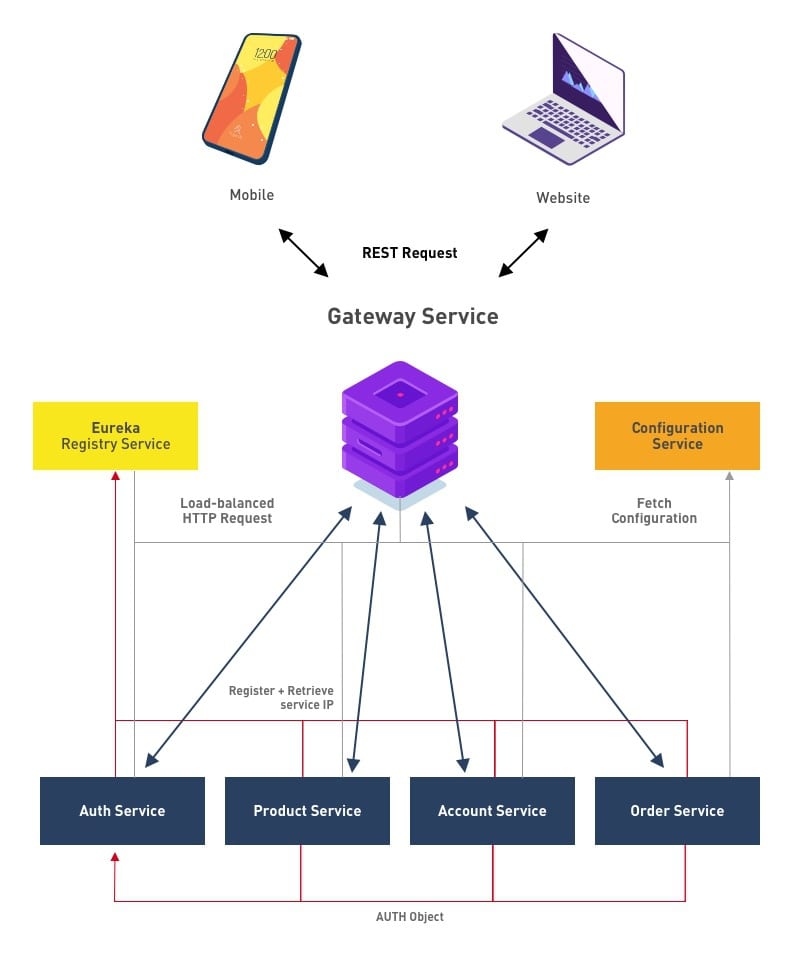
Let’s go back to the map of Microservices. 

We can see that not all services are directly accessible by our front end apps. All requests from the front-end will be managed, balanced, and redirected to the target service. In fact, all our functional services can be access directly by the front-end, but issues can arise as the front-end requires access to more and more services. When the front-end needs to call a service directly, it may use protocols that are not web-friendly.  

Calling Microservices directly also have another potential drawback in that it makes difficult to refactor the Microservice. We may need to change how the service is partitioned, and this can affect the client that calls it if it communicates directly with the services. For this reason, it rarely makes sense for clients to talk directly to a Microservice. 

Introduction Gateway Service 

The Gateway service acts as an entry point into our Microservice system. This service encapsulates the system architecture and provides an API that is tailored to each client. We can also add other responsibilities to it, such as authentication, monitoring, load balancing, caching, request shaping and management, and static response handling. 

The Gateway service is responsible for routing, composition, and protocol translation. All requests from clients should go to the Gateway which will route requests to the appropriate Microservice. Sometimes the Gateway service handles a request by invoking multiple Microservices and aggregating the results. One example of using a Gateway is enabling the client to retrieve product details with single request (/productdetails?productid=xxx). The Gateway handles the client request by invoking various services (ex: product inifo, reviews, balance, recomendations) and combining the results. 

Creating Gateway Service 

We will use the project layout described in article A Journey with Microservices (part 2) because it already provides us with multi-modules and minimises repetition. We will create new module called gateway-service inside our non-functional module, and add this in our pom.

<dependencies>
<dependency>
<groupId>org.springframework.cloud</groupId>
<artifactId>spring-cloud-starter-gateway</artifactId>
</dependency>
<dependency>
<groupId>org.springframework.cloud</groupId>
<artifactId>spring-cloud-starter-config</artifactId>
</dependency>
<dependency>
<groupId>org.springframework.boot</groupId>
<artifactId>spring-boot-starter-aop</artifactId>
</dependency>
<dependency>
<groupId>org.springframework.retry</groupId>
<artifactId>spring-retry</artifactId>
</dependency>
<dependency>
<groupId>org.springframework.cloud</groupId>
<artifactId>spring-cloud-starter-netflix-eureka-client</artifactId>
</dependency>
<dependency>
<groupId>org.springframework.boot</groupId>
<artifactId>spring-boot-starter-actuator</artifactId>
</dependency>
</dependencies>
<build>
<plugins>
<plugin>
<groupId>org.springframework.boot</groupId>
<artifactId>spring-boot-maven-plugin</artifactId>
</plugin>
<plugin>
<groupId>com.spotify</groupId>
<artifactId>dockerfile-maven-plugin</artifactId>
</plugin>
</plugins>
</build>

Dont forget to create the bootstrap.yml inside the resources folder so that the Gateway service will load its configuration from the configuration-service.

Bootsrap.yml

spring:
application:
name: gateway
cloud:
config:
uri:
- http://localhost:9090
fail-fast: true
retry:
initialInterval: 5000
maxInterval: 5000
maxAttempts: 10

Next, create the configuration file for the gateway-service in configuration-service resources->config folder and use this configuration.

spring:
cloud:
gateway:
x-forwarded-for:
enabled: true
discovery:
locator:
lower-case-service-id: true
enabled: true
routes:     
- predicates:
- Path=/hello/**
filters:
- StripPrefix=1
uri: "https://www.mitrais.com/"
# EUREKA DISCOVERY
eureka:
client:
healthcheck:
enabled: true
registerWithEureka: false
fetchRegistry: true
serviceUrl:
defaultZone: http://localhost:9091/eureka
instance:
instanceId: ${spring.application.name}:${spring.application.instance_id:${random.value}}
leaseRenewalIntervalInSeconds: 5   # DO NOT DO THIS IN PRODUCTION
# TOMCAT
server:
port: 8081
# ACTUATOR ENDPOINTS
management:
endpoints:
web:
exposure:
include:
- health
- info
- env

As we can see in this configuration, we route the url path “/hello/” to open the mitrais home page. To test it, lets move on to creating a spring boot application.

We use Spring Cloud’s @EnableDiscoveryClient to activate the Netflix Eureka DiscoveryClient implementation in our Spring Boot application.

import org.springframework.boot.SpringApplication;
import org.springframework.boot.autoconfigure.SpringBootApplication;
import org.springframework.cloud.client.discovery.EnableDiscoveryClient;
@SpringBootApplication
@EnableDiscoveryClient
public class GatewayMain {
public static void main(String[] args) {
SpringApplication.run(GatewayMain.class, args);
}
}

Testing

To test the service, we run the Configuration and Gateway services in sequence. Opening  a browser and accessing the URL http://localhost:8081/hello will redirect you to the Mitrais homepage. If the URL http://localhost:8081/hello/about-us/ is used, it will redirect us to Mitrais’ About Us web page.

Thats all for our journey with Microservices for now. In the next part we will look at the Registry service and how it is used in our Microservice architecture.

Author:
I Kadek Dendy Senapartha – Analyst Programmer Mitrais

Mitrais Takes Steps to Prevent Coronavirus

In January 2020, the World Health Organization (WHO) declared the outbreak of a new coronavirus (COVID-19) in Hubei Province, China, to be a Public Health Emergency of international concern, and in March, declared it to be a global pandemic.

Like everyone, Mitrais takes COVID-19 very seriously. We are very conscious of our responsibilities to our staff and clients, and have taken immediate steps to mitigate the risks associated with this event.

We stress that, as of today, there are no confirmed cases of COVID-19 within Mitrais staff or their families. The average age and fitness of our staff suggests that any symptoms experienced are likely to be mild, but Mitrais is proactively addressing the risks.

Mitrais is always committed to providing a safe and healthy working environment, and we are closely monitoring developments in the region and Indonesian Government advisories. As part of Mitrais’ Workplace Health and Safety Initiative, we have put in place preventive measures, and continue to monitor and respond to recommendations from the WHO. These health measures include monitoring, upgraded office cleaning protocols, increased sanitization and self-quarantine practices. We have established an internal Pandemic Response Team and under their guidance we have refined and communicated our Standard Operating Procedures (SOP) with all staff. We have provided hand sanitizer in all our offices and encouraged staff to implement diligently frequent and effective hand washing, covering of mouth and nose with tissue paper when they cough or sneeze, and encourage the use of masks when necessary.

In the interests of proper care, we have implemented body temperature monitoring for staff and visitors arriving at Mitrais offices using contactless thermometers from 3 March. If temperature reading of 37.5°C or above is returned and the person is experiencing any flu-like symptoms, has knowingly been in contact with a confirmed or potentially infected person, or has recently visited a high-risk country, we will require them to self-isolate, working from home for a minimum of 14 days or as otherwise prescribed by a medical specialist. Our Mitrais Pandemic SOP defines clear steps of action in case of any potential outbreak detected in our offices or the surrounding area.

Although there are currently no compulsory steps required in Indonesia, the Indonesian President published advice on 15 March which read “Under the current conditions, it’s time for us to work from home, study from home, and worship at home”. In response, Mitrais’ Pandemic Response Team has activated our preparation to immediately move toward a work-from-home model where possible. Some of our production staff are already operating in this mode, and plans are now in place to expand this to more of our teams imminently. Teams will transition to this mode in close consultation with our clients to ensure continuity of our services.

Our absolute priorities are the health of our staff and visitors, and the uninterrupted provision of Mitrais’ quality services and support to our clients in line with our mantra of Continuous Commitment.

Indonesian-Australian Free Trade Agreement from July 5, 2020

Following extensive negotiations over several years, Indonesia and Australia have ratified the Indonesia-Australia Comprehensive Economic Partnership Agreement (IA-CEPA) which will come into effect from July 5, 2020.

The IA-CEPA seeks to create a framework for Australia and Indonesia that will enable both to fully leverage the potential of the bilateral economic partnership, allowing the growth of economic cooperation between businesses, communities, and individuals.

Indonesia has been a growing market for Australian goods and services exporters, with 2018-19 total two-way trade in goods and services worth A$17.8 billion. This makes Indonesia Australia’s 13th largest trading partner, and the IA-CEPA is designed to provide Australian and Indonesian businesses the opportunity to expand and diversify this economic partnership further.

As one of the fastest growing economies in the Indo-Pacific, Indonesia presents a significant opportunity for Australian businesses. By some estimates, Indonesia will be the world’s fifth-largest economy by 2030, and with the IA-CEPA Australia is well-placed to deepen economic cooperation and share in Indonesia’s growth. The two strategic partners and largest economies in Southeast Asia now share an agreement that also complements and supports our shared interest in fostering a secure and prosperous region.

Business Council of Australia chief executive, Jennifer Westacott, said “This agreement locks in bilateral trade and investment so that as Indonesia’s economy grows, Australia prospers”.

While much of the attention has been focused on the greater opportunities for Australian farmers and other agricultural exports under the deal, universities may also be one of the big winners. Melbourne’s Monash University has recently announced plans to open a campus in Indonesia, which would be the first majority-owned foreign university in the country – something the IA-CEPA deal has made possible.

The IA-CEPA also offers the opportunity to further strengthen relationships between Indonesian IT providers and Australia clients. Mitrais has partnered with a wide range of Australian organisations for more than 2 decades, during which it has established itself as a premier provider of outsourced software development teams for Australian businesses. So much so, that Forrester Research has rated Mitrais as Indonesia’s leading provider of offshore software development services.

Founded by Australian David Magson in 2000, Mitrais grew out of Mincom Indoservices, a joint venture with Australian software giant Mincom in the early 1990s. David has been a committed advocate for Indonesian-Australian business engagement throughout, and sees the consolidation of the IA-CEPA agreement as vindication of its importance. And it seems the world agrees. Leading analysts, AT Kearney, rated Indonesia as one of the world’s top 4 locations for the delivery of services on its 2019 Global Services Location Index based on financial attractiveness, people skills and availability, business environment and digital resonance.

Part of the global CAC Holdings Group from 2019, Mitrais continues to focus on creating and maintaining long-term high-trust relationships with Australian business by augmenting their Australian software development teams with the additional capacity and capability that they require and continuing to add value to their organisations.

Innovation is Inevitable

Whitcomb L. Jackson, an American mechanical engineer, made something that was originally called a clasp-locker. With further development, the clasp-locker was developed to become the common zipper that we all know today. By using a zipper, we can easily open and close bags, trousers, shirts etc, and our lives are made that much easier. However, the zipper would not exist without serious innovation – and this is true for many of the complicated and sophisticated pieces of technology we find in our daily lives, driven by the very human desire to solve problems and make things better.

“Innovation is seeing what everybody has seen and thinking what nobody has thought”.

Albert Szent-Györgyi, Hungarian Biochemist, 1937 Nobel Prize Awardee in Physiology or Medicine

Innovation is intrinsic in the human condition and can be found in all parts of life. The changes in environment, social structures and technology have continually pushed humans to keep innovating and striving for a better way. As humans, our brains offer us incredible potential to see alternatives in all areas of our life, encouraging us to innovate, survive and thrive in our ever-changing, highly competitive world.  For businesses, without innovation, they simply will not stand the test of time and will instead fall far behind their competitors as technology and trends shift and change. We’ve seen many businesses, once considered to be world leaders in their field, fall far behind their competitors because they refused to, or we unable to, innovate. By seeing and understanding the current market, technology and trends, any organization should be encouraged to apply new processes, procedures, methods, products, and services to create innovation in their business.

With the COVID-19 pandemic affecting millions of people around the globe, companies need to adapt, change and innovate to survive, and hopefully see that the current pandemic is an opportunity to grow and evolve their business. We see banking and finance institutions are reducing services that involve face-to-face and physical interactions with their customers, while innovating and enhancing their mobile application capabilities so they can support broader and more personalized online banking and financial services. This could result in more sophisticated and advanced mobile applications, which may be far superior to that of their competitors, giving them a distinct advantage in the cluttered marketplace. One door is indeed closed, but instead, other doors are opened.

One of the most important challenges of applying innovation in an organization is within company leadership. Leaders really should have a broader, better, and clearer view of the organization’s goals than their staff, allowing them to initiate innovation, set the direction and encourage change across all stakeholders. Leaders generally have capabilities that allow them to shape the organization’s culture to encourage innovation and new ideas. A strong leader is required – without any doubt – to apply innovation to all parts of a company to continue their operations, to compete in the market and to achieve the organization’s goals.

In most cases, innovation is not easy. In many situations, roadblocks occur that hamper adoption and innovation, such as:

  • Lack of bandwidth – Often companies are too busy producing and selling their existing products or services, leaving limited resources to initiate and to develop innovation, which can have a serious impact on the sustainability of the company overall.
  • Fear of change – The argument “we have always done it this way” is a common roadblock for innovation. A stagnation of your team or company, leaving your employees stuck firmly in the ‘comfort zone’, can really hold your organization back.
  • Additional cost – In most cases, an organization does not dedicate sufficient budget for innovation. Companies tend to allocate the budget to areas that offer a quick return on investment, which innovation may or may not do.
  • Lack of technical expertise – To innovate, having technical expertise is a must. Many organizations are hesitant to innovate, as they think they do not have sufficient knowledge and experience to work on these new areas or new technologies. 
  • Too risky – Innovation may mean more risk for an organization. Without proper planning, calculation and execution, there is strong possibility that innovation may be a costly exercise, rather than one that generates more revenue or new opportunities.

When you consider those roadblocks and once you understand how important innovation is, there is a clear path to encourage innovation within your organization, while alleviating roadblocks – and that is by working with capable outsourcing providers to support the company in key innovation areas. By engaging other parties that are specialized and have strong expertise, companies have access to a team that will help and support innovation initiatives within the organization.

The benefits of outsourcing your innovation are many, including:

  • Focussing on areas of expertise – Organizations can instead focus on their core business activities and let outsourced providers focus on key innovation initiatives without hiring more employees, allowing them to focus on their tasks and area of expertise, offering greater efficiencies and stronger results.
  • Fresh eyes and ideas – Engaging third-party providers mean inviting fresh eyes and ideas into the organization. Injecting people from outside of the organization who have different experience and exposure will bring new ideas, different ways of thinking and new perspectives, which can lead an organization towards innovation. 
  • Lower labor costs – When outsourcing, companies can lower the cost of labour on key activities, like software development, because the company does not need to carry the cost of additional employees, including wages, taxes and training, as this is completely handled by the third-party provider.
  • Sufficient technical skills and exposure – Typically, third-party providers have the right technical skills and specialization in key areas, allowing them to be true experts. They tend to follow the current trends, continually innovate within their field, are up to date with the latest technologies and equipped with advanced skills. They then share this in-depth knowledge with companies, showing them how to innovate within their own industries or market space, without the need to develop that in-depth expertise themselves.
  • Risk-sharing – By engaging with external providers, the risk of innovation on the organization is shared and lessened. Outsourced providers offer expertise in their field and an existing investment in equipment, staff and skills, which removes this risk from the company. Because they are experts in a key area, the risk is not great to the third-party provider, allowing a company experimenting with innovation to have access to these elements, without shouldering the responsibility themselves.

Over the past 20 years, software development has become a key area to support innovation within an organization. This often allows the organization to provide better products and services to their customers, and increase their profit. However, technology is ever-changing, at a faster and faster pace, meaning innovation plays an even more crucial role. By engaging the right outsourcing providers for your organization for software development, you ensure that you position your company for a future in the changing digital landscape. With advanced technical skillsets and updated technologies, your outsourcing providers should become an important partner for your organization to continue innovating and maintain pace with the latest trends and stay one step ahead of your competition.

Innovation is a never-ending journey that encourages companies to see and take advantage of opportunities and evolve the way they do business. Without room for innovation and improvement, companies stagnate and are pushed out of their market. To avoid this, we – as a person, team, organization, and society – have to keep innovating to invent and improve all areas of life, to make living better. We as humans are equipped with the brain, knowledge, experience, and ability to adapt to life’s challenges, and to see new ways of doing things better, faster and stronger. Innovation is indeed inevitable.

Author:
Edwind Arhandhika – Engagement Manager